## What PSI pressure washer do I need to clean siding?
Wrong PSI is the easiest way to ruin your siding in an afternoon.
You rented or bought a pressure washer, aimed it at your house, and now you're worried you chose too much power or too little. Too high and you crack vinyl, force water behind boards, or blast paint off wood. Too low and you're just moving dirt around without removing it.
This article gives you the exact PSI ranges for every common siding material, explains which machines actually hit those numbers reliably, and flags the mistakes that send homeowners back to the hardware store.
---
## Why PSI matters more than you think
PSI stands for pounds per square inch. It measures how hard the water hits the surface.
Siding is not one material. Vinyl, wood, fiber cement, brick, and stucco each have different tolerances. What cleans brick safely will split vinyl planks or force moisture behind wood lap siding, causing mold and rot you won't find for months.
Here's what most guides miss: PSI alone doesn't tell the whole story. The nozzle angle changes the effective pressure at the surface dramatically. A 0-degree (red) nozzle concentrates all that force into a pinpoint. A 40-degree (white) or 65-degree (black) nozzle spreads it wide. For siding, you almost always want the 25-degree or 40-degree tip.
But you still need to start with the right machine.
---
## PSI ranges by siding type
### Vinyl siding
**Recommended PSI: 1,300 to 1,600**
Vinyl is the most common residential siding and the most forgiving to clean, but it has a hard ceiling. Above 2,000 PSI at close range, you risk cracking panels, warping joints, or driving water up behind the boards where it can't dry out.
For standard vinyl, a 1,500 to 1,800 PSI machine used at a 45-degree angle from a safe distance (at least 12 to 18 inches from the surface) handles most dirt and mildew without damage. Keep the wand moving. Never hold it in one spot.
### Wood siding (painted or stained)
**Recommended PSI: 500 to 1,200**
Wood is the most vulnerable. Painted wood siding can delaminate, raise grain, or absorb water that causes swelling and rot if you use too much pressure or the wrong angle. Stay below 1,200 PSI and use a wide 40-degree tip. Work with the grain, not against it. Keep the nozzle moving at a consistent pace.
For weathered or older painted wood, go lower, around 500 to 800 PSI, and consider a house wash detergent to let chemistry do the heavy lifting instead of raw pressure.
### Fiber cement (HardiePlank and similar)
**Recommended PSI: 1,500 to 2,000**
Fiber cement handles more pressure than wood but less than brick. It's sealed on installation, and a pressure washer that exceeds 2,000 PSI at close range can chip or pit the surface coating over time. Stick to 1,500 to 2,000 PSI with a 25 to 40-degree tip and work at 18 inches or more from the surface.
### Brick and masonry
**Recommended PSI: 1,500 to 3,000**
Brick tolerates higher pressure because the material is dense and not prone to delamination. However, older brick with deteriorating mortar is a different story. Blasting aged mortar joints at 2,500 or 3,000 PSI can erode them noticeably. For older homes, stay under 2,000 PSI and inspect the mortar before you start.
### Stucco
**Recommended PSI: 1,200 to 1,500**
Stucco is porous and can crack under high pressure, especially if it's already showing hairline fractures. Keep pressure below 1,500 PSI and use a sweeping motion. Avoid 0-degree and 15-degree nozzles entirely on stucco.
---
## Which machines hit the right PSI for siding?
For most homeowners cleaning vinyl, fiber cement, or wood siding, you need a machine that delivers 1,500 to 2,000 PSI reliably. Gas machines over 3,000 PSI are genuinely too much for residential siding unless you're very experienced with distance and technique.
Here's the interesting part: electric pressure washers in the 1,800 to 2,100 PSI range are actually better suited for siding than most gas machines. They're easier to control, start instantly, and rarely produce the sudden pressure spikes that crack vinyl.
The Sun Joe SPX3000 runs at 2,030 PSI with two onboard detergent tanks. At that pressure, with a 40-degree nozzle and proper standoff distance, it cleans vinyl, fiber cement, and lightly soiled wood without the white-knuckle risk of a 3,000 PSI gas unit. It runs around $150 to $180, making it one of the most practical choices for a homeowner who cleans siding once or twice a year. The limitation: it's corded, so you'll need a long outdoor extension cord rated for the amperage, and it won't match a gas machine for stripping heavy paint or very stubborn staining.
If you want slightly lower pressure for delicate wood siding, the Greenworks 2000 PSI runs between $150 and $200 and delivers consistent, controllable output. The pressure doesn't spike erratically the way some budget machines do, which matters when you're working close to painted wood. The trade-off is that it tops out at 2,000 PSI, so it won't handle heavily scaled masonry or commercial-grade buildup.
For a full breakdown of options across price points, see our [best electric pressure washer for 2026](/article/best-electric-pressure-washer-2026) guide.
---
## The technique errors that matter as much as PSI
The wrong angle does more damage than the wrong machine. Always spray downward at a slight angle that pushes water away from the wall, not up behind siding edges. Spraying upward forces water under laps and into wall cavities.
Distance is the other variable people underestimate. At 6 inches from the surface, 1,500 PSI behaves more like 2,500. At 24 inches, it behaves more like 800. Start far and move closer only if you're not cutting through the grime.
Detergent does the work on biological stains. Mold, mildew, and algae respond to a house wash solution far better than raw pressure alone. Apply detergent with a low-pressure nozzle or the soap setting, let it dwell for 5 to 10 minutes, then rinse at normal pressure.
For a complete walkthrough of technique, the [how to pressure wash a house safely](/article/how-to-pressure-wash-house-safely) article covers the full process step by step.
If you're cleaning a two-story home, the logistics change. See our [what size pressure washer for a 2-story house](/article/what-size-pressure-washer-for-2-story-house) guide for reach and equipment considerations.
---
## Quick reference: PSI by siding type
- **Vinyl siding:** 1,300 to 1,600 PSI (25 or 40-degree tip) - **Wood siding:** 500 to 1,200 PSI (40-degree tip, work with the grain) - **Fiber cement:** 1,500 to 2,000 PSI (25 or 40-degree tip) - **Brick and masonry:** 1,500 to 3,000 PSI (check mortar condition first) - **Stucco:** 1,200 to 1,500 PSI (wide tip only)
---
## Frequently asked questions
**Q: Can I use a 3,000 PSI pressure washer on vinyl siding?**
You can, but you need very good distance control and a wide-angle nozzle. At 3,000 PSI and close range, vinyl cracks and joints separate. If you already own a high-PSI machine, use the 40-degree tip, stay at least 24 inches from the surface, and keep the wand moving constantly. A 1,800 to 2,000 PSI electric machine is genuinely safer for this job.
**Q: What PSI do professionals use to clean house siding?**
Most professional house wash crews use 1,500 to 2,500 PSI for standard residential siding, combined with soft wash detergent solutions that reduce the pressure needed. Some use dedicated soft wash systems that run below 500 PSI and rely almost entirely on chemistry. The high-PSI numbers you see on commercial equipment are used for concrete and industrial surfaces, not home siding.
**Q: Is 2,000 PSI enough to remove mildew from siding?**
Yes, for most mildew. The key is using a detergent formulated for house washing. Apply the solution first, let it sit, then rinse at 1,500 to 2,000 PSI. Pressure alone without detergent often just moves mildew spores rather than killing them.
**Q: Do I need a gas or electric pressure washer for siding?**
For siding specifically, electric is usually the better choice. Gas machines are harder to throttle and commonly exceed 2,500 PSI, which is more than most siding needs. Electric machines in the 1,800 to 2,100 PSI range are easier to control, lighter, and work well for the job. See our [electric vs gas pressure washer](/article/electric-vs-gas-pressure-washer) comparison if you're still deciding.
**Q: How far should I hold the pressure washer from siding?**
Start at 24 inches and move closer only if needed. For wood, stay at 18 to 24 inches minimum. For fiber cement and vinyl, 12 to 18 inches at 2,000 PSI is workable. For brick, you can go as close as 6 to 12 inches depending on the condition of the mortar.
Recommended Products
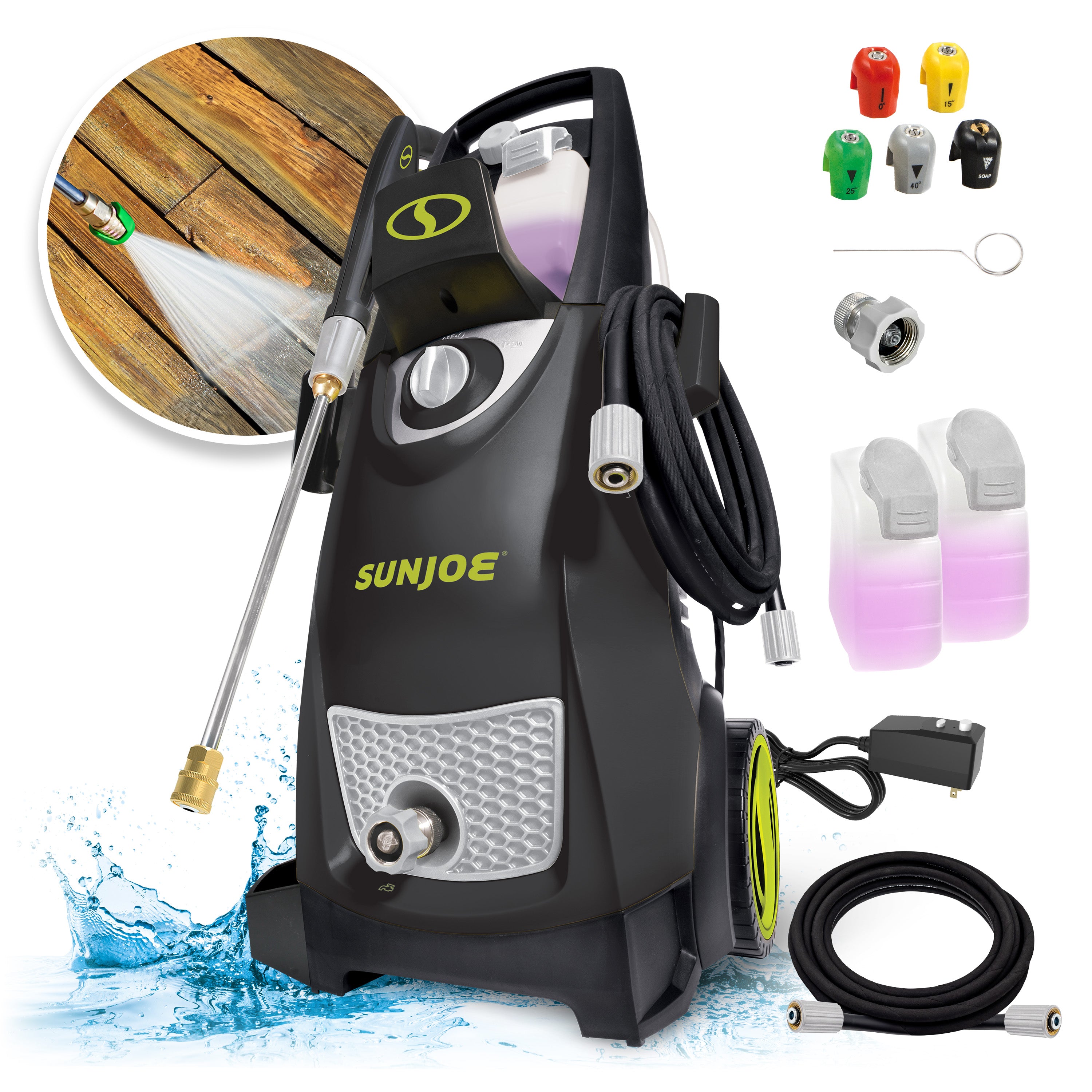
Sun Joe SPX3000
Powerful electric pressure washer with 2030 PSI, perfect for homeowners.
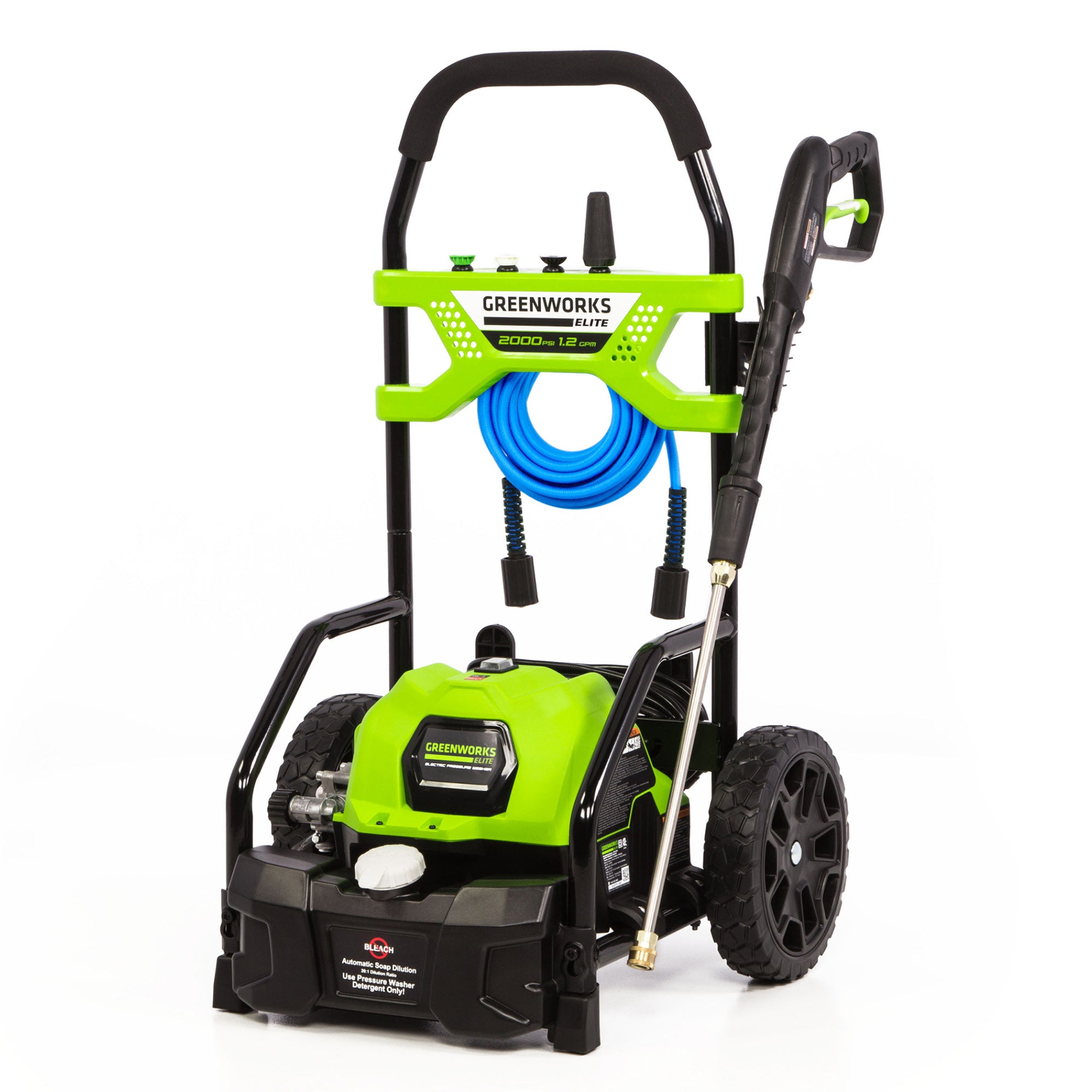
Greenworks 2000 PSI
Reliable electric washer with consistent pressure and cordless convenience.
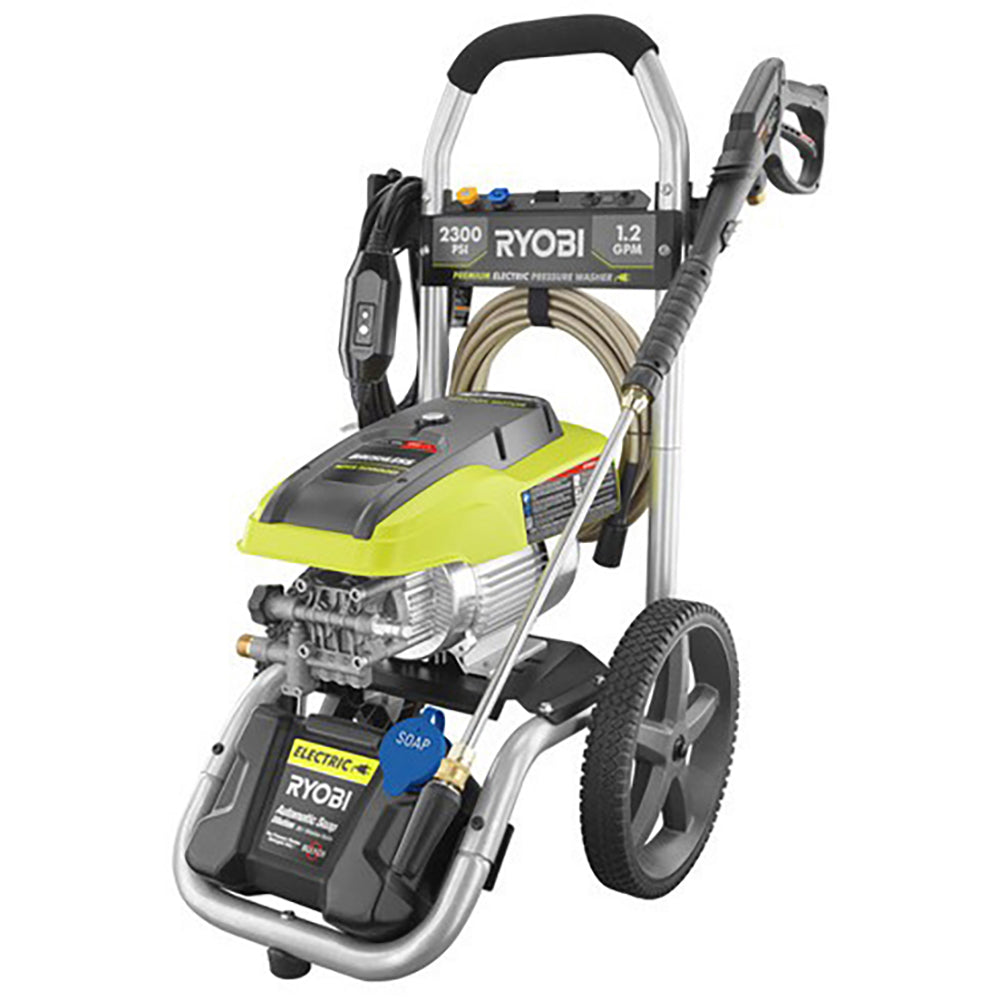
Ryobi 2300 PSI
Premium electric model compatible with Ryobi battery systems.